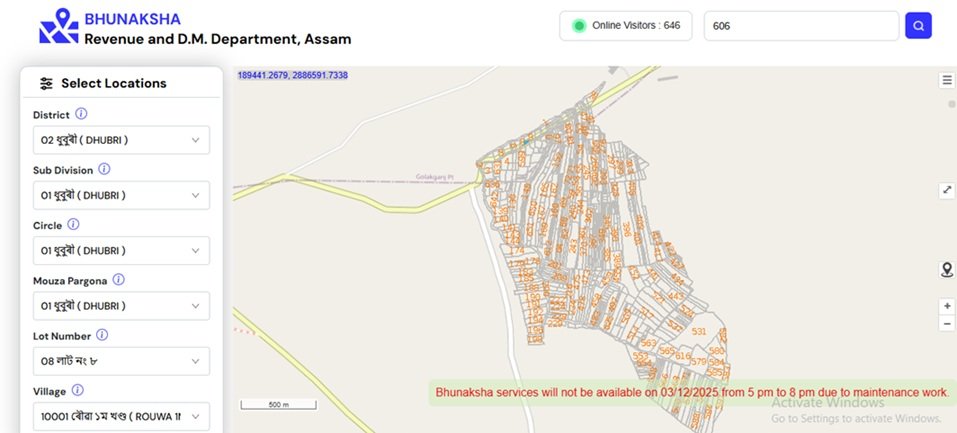
Maps have continually been an critical tool for understanding geography, planning trips, and reading locations. In Assam, a northeastern state of India, BHU Naksha Assam has emerge as more and more critical for college kids, researchers, and citizens alike. The time period refers to particular maps that display villages, cities, rivers, roads, and administrative barriers across Assam.
What is BHU Naksha Assam?
BHU Naksha Assam is largely an in depth geographic map supplied by means of the Barak Humanitarian Unit (BHU) or different mapping authorities in Assam. These maps offer visible illustration of regions, showing various geographical and administrative details such as:
- Villages and cities
- Rivers and water bodies
- Roads, highways, and railways
- Forests and flora zones
- Administrative limitations like districts and blocks
These maps are very beneficial for authorities planning, educational research, and for citizens who want to understand extra about their state.
Importance of BHU Naksha Assam
The importance of BHU Naksha Assam can not be overstated. Here are some key reasons why these maps are valuable:
1. Administrative Planning
Government authorities use BHU Naksha Assam to plan development tasks, allocate assets, and manipulate districts correctly. For example, whilst building a brand new street or college, officials consult these maps to apprehend the terrain and population distribution.
2. Educational Purposes
Students and instructors use BHU Naksha Assam for geography training, environmental studies, and venture paintings. The maps assist in studying approximately rivers, hills, and population facilities in Assam.
3. Agricultural Use
Farmers and agricultural planners use those maps to understand land use patterns, irrigation points, and soil types. This enables in making plans plants and enhancing productiveness.
4. Disaster Management
Assam is liable to floods, specially in areas close to the Brahmaputra River. BHU Naksha Assam helps authorities pick out flood-prone regions and plan alleviation operations successfully.
5. Tourism and Travel
Tourists use these maps to discover Assam, locate points of interest, and plan travel routes. From Kaziranga National Park to Majuli Island, BHU Naksha Assam helps in navigation and itinerary making plans.
Types of BHU Naksha
There are one-of-a-kind varieties of BHU Naksha Assam primarily based on their reason and element stage.
1. Political Maps
These maps show administrative obstacles, consisting of districts, blocks, and villages. They are useful for knowledge governance structures.
2. Physical Maps
Physical maps highlight natural features like rivers, mountains, hills, and forests. These are useful for environmental studies and tourism making plans.
3. Topographical Maps
Topographical maps display elevation, slopes, and landforms in element. They are in particular helpful for construction, city making plans, and studies functions.
4. Thematic Maps
Thematic maps recognition on particular topics which includes population density, rainfall styles, or land use. They assist researchers and planners examine precise components of Assam.
Features of BHU Naksha Assam
Understanding the key functions of BHU Naksha Assam is important for proper interpretation:
- Legends – Explain the symbols used on the map. For instance, a inexperienced region may constitute forests, whilst blue lines indicate rivers.
- Scale – Shows the ratio of map distance to real distance. A scale of one:50,000 manner 1 cm at the map equals 50,000 cm in truth.
- Coordinates – Latitude and longitude help discover locations as it should be.
- Boundaries – Show district and block limits.
- Landmarks – Important locations like colleges, hospitals, temples, and tourist spots are marked.
By studying these functions carefully, absolutely everyone can get a clean know-how of Assam’s geography.
How to Use BHU Naksha Assam
Using BHU Naksha Assam successfully requires some simple steps:
- Identify Your Area of Interest – Start through finding the district or village you need to have a look at.
- Check the Legend – Understand the symbols for roads, rivers, buildings, and forests.
- Measure Distances – Use the scale to calculate distances between locations.
- Analyze Terrain – Look at elevation and physical capabilities to plot trips, construction, or research.
- Cross-reference with Other Maps – Sometimes, the usage of satellite maps or Google Earth together with BHU Naksha Assam gives a higher information.
For instance, a student reading flood-inclined areas can perceive rivers and low-lying regions the usage of the map and plan for this reason.
Practical Examples
- Urban Planning: A municipal business enterprise planning a new street in Guwahati can test BHU Naksha Assam to avoid disrupting residential areas and herbal habitats.
- Agriculture: Farmers in Dibrugarh can identify irrigation points and plan crop rotation the use of the maps.
- Tourism: Tourists traveling Majuli Island can use those maps to discover ferry points, temples, and visitor homes.
- Disaster Management: During floods, authorities can become aware of evacuation routes and flood-susceptible villages the use of BHU Naksha Assam.
Advantages of BHU Naksha Assam
- Accurate and Detailed – Shows villages, roads, rivers, and forests precisely.
- Educational Resource – Helpful for college kids, researchers, and instructors.
- Supports Planning – Assists in governance, agriculture, tourism, and disaster control.
- Easy to Interpret – With legends and scales, all people can recognize the information.
- Versatile Usage – Applicable in government, schooling, studies, and every day existence.
Challenges and Limitations
- Updates Required – Maps need frequent updates due to converting geography, new roads, and urban expansion.
- Limited Digital Access – Some distinctive maps may not be available on-line.
- Interpretation Skills Needed – Users want basic know-how of maps to examine symbols and scales efficiently.
With these challenges in mind, customers should combine BHU Naksha with satellite photographs and nearby surveys for the first-rate results.
Conclusion
BHU Naksha Assam is extra than only a map; it’s miles a powerful device for know-how Assam’s geography, planning development, and making informed decisions. From students and researchers to government officials and tourists, those maps serve more than one functions.
FAQs
Q.1: What is BHU Naksha Assam?
Ans: BHU Naksha Assam is a detailed map of Assam displaying villages, towns, rivers, roads, forests, and administrative barriers.
Q.2: Who can use BHU Naksha Assam?
Ans: Students, researchers, government officials, travelers, and citizens of Assam can use those maps for planning, have a look at, and navigation.
Q.3: How correct is BHU Naksha Assam?
Ans: BHU Naksha Assam is incredibly correct, but maps require periodic updates to mirror new tendencies and geographical adjustments.
Q.4: Can BHU Naksha Assam assist in catastrophe management?
Ans: Yes, it allows pick out flood-prone regions, evacuation routes, and secure zones, making it useful for making plans throughout herbal disasters.
Q.5: Where can I get admission to BHU Naksha ?
Ans: BHU Naksha Assam may be acquired from authorities mapping departments or instructional establishments, and a few versions are available for educational use.
Leave a Reply